RELEASE DATE - 2026.06.09
When selecting a cam lock for industrial equipment, electrical enclosures, outdoor cabinets, or OEM products, engineers often focus on dimensions, key systems, and installation requirements. However, one of the most important factors affecting long-term performance is the material of the lock itself.
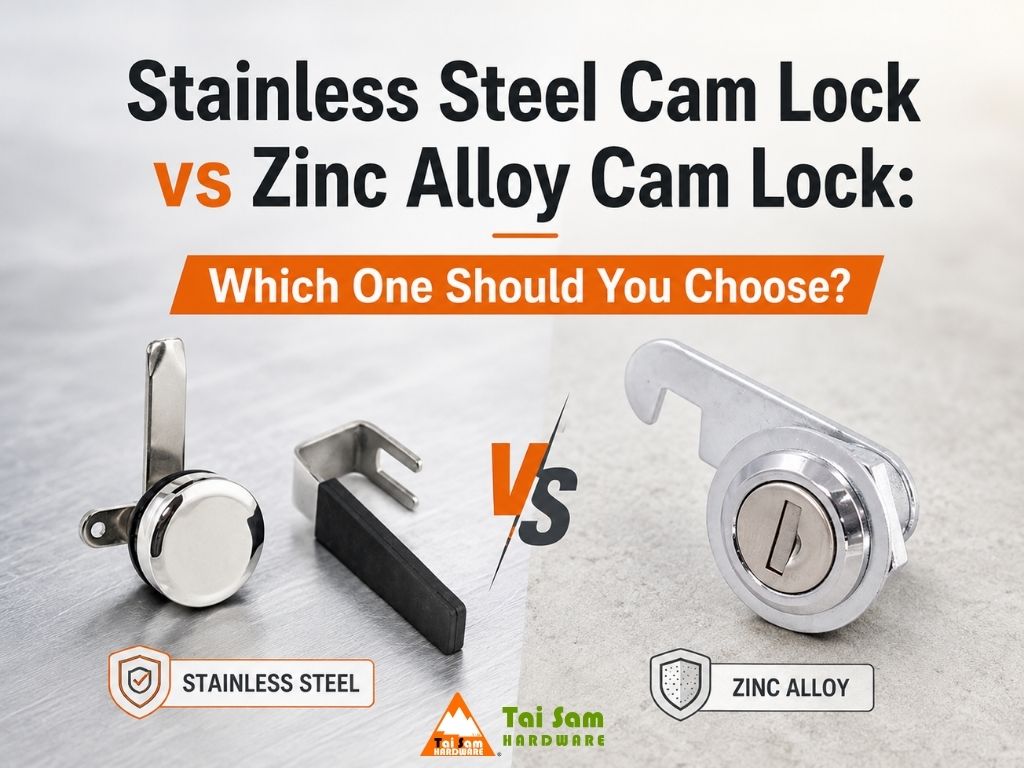
Among the most common choices on the market are stainless steel cam locks and zinc alloy cam locks. While both can provide reliable locking performance and secure access control, they differ significantly in terms of corrosion resistance, durability, maintenance requirements, and overall lifecycle cost.
At TAI SAM HARDWARE CO., LTD., we support OEM manufacturers and equipment builders across various industries, and one of the most common questions we receive is: Which material should I choose for my cam lock application?
The answer depends on where the lock will be used, how often it will be operated, and how long it is expected to perform reliably. This article compares stainless steel and zinc alloy cam locks side by side to help engineers, designers, and buyers make the right decision.
A stainless steel cam lock is manufactured primarily from stainless steel materials such as SUS304 or SUS316. Unlike plated materials, stainless steel provides corrosion resistance throughout the entire material structure.
Because of its excellent resistance to moisture, chemicals, and environmental exposure, stainless steel is widely used in outdoor electrical enclosures, telecommunications cabinets, EV charging stations, food processing equipment, marine applications, and industrial automation systems.
Stainless steel cam locks are often selected when reliability and durability are more important than minimizing initial cost.
Zinc alloy cam locks are typically manufactured through a die-casting process and then finished with surface treatments such as chrome plating, nickel plating, or powder coating.
The popularity of zinc alloy comes from its cost-effectiveness, good dimensional accuracy, attractive appearance, and ease of mass production.
For indoor equipment and controlled environments, zinc alloy cam locks provide dependable performance while maintaining a competitive price point. They are commonly found in office furniture, indoor electrical cabinets, server racks, storage cabinets, and general industrial equipment.
| Feature | Stainless Steel Cam Lock | Zinc Alloy Cam Lock |
|---|---|---|
| Corrosion Resistance | Excellent | Good |
| Outdoor Performance | Excellent | Moderate |
| Salt Spray Resistance | Excellent | Depends on surface coating |
| Mechanical Strength | High | Good |
| Surface Durability | Excellent | Coating may wear over time |
| Maintenance Requirements | Low | Moderate |
| Product Lifespan | Long | Medium |
| Initial Cost | Higher | Lower |
| Long-Term Value | Excellent | Good |
| Harsh Environment Suitability | Highly Recommended | Limited |
The comparison shows that neither material is universally better. Instead, the best choice depends on the operating environment and project requirements.
The advantages of stainless steel become increasingly apparent when equipment is exposed to challenging conditions.
Outdoor electrical cabinets are exposed to rain, humidity, UV radiation, and temperature fluctuations every day. In these environments, corrosion can gradually compromise locking performance and appearance.
Because stainless steel naturally resists rust and environmental degradation, it provides greater reliability over years of outdoor use.
As EV infrastructure continues to expand globally, charging stations are increasingly installed in public outdoor locations.
Operators expect these installations to remain secure and operational with minimal maintenance. Stainless steel cam locks help reduce service requirements while maintaining a professional appearance.
Salt-laden air is one of the most aggressive causes of corrosion. Equipment installed near ports, coastal facilities, offshore platforms, or marine vessels requires hardware that can withstand continuous salt exposure.
For these applications, stainless steel is often the preferred choice.
Food processing facilities frequently involve washdowns, cleaning chemicals, and high humidity levels. Stainless steel hardware is often specified because it resists corrosion while supporting sanitary equipment design.
Although stainless steel offers many advantages, zinc alloy remains a practical solution for numerous applications.
Many industrial machines operate inside climate-controlled factories where moisture and corrosive contaminants are limited.
In these environments, zinc alloy cam locks can provide excellent performance without the higher cost associated with stainless steel.
Office cabinets, lockers, and indoor storage systems rarely face harsh environmental conditions. Zinc alloy provides sufficient durability while maintaining an attractive finish.
For large-volume manufacturing projects, component cost can have a significant impact on overall production budgets.
When environmental exposure is minimal, zinc alloy cam locks can help reduce costs without sacrificing functionality.
Not every application requires maximum corrosion resistance. For light-duty access doors and service panels located indoors, zinc alloy often provides the most economical solution.
Many purchasing decisions focus on the initial component price. However, experienced engineers often evaluate the total cost of ownership (TCO) instead.
The true cost of a cam lock includes initial purchase price, installation costs, maintenance requirements, replacement frequency, downtime risks, and service labor costs.
A zinc alloy cam lock may cost less initially, but if corrosion or coating degradation requires replacement several years later, the total cost may exceed that of a stainless steel alternative.
For remote installations, critical infrastructure, or equipment expected to remain in service for many years, stainless steel often delivers better long-term value despite the higher upfront investment.
Material selection also affects how customers perceive the quality of a finished product.
Stainless steel offers a premium appearance, long-term surface stability, better resistance to scratches and discoloration, and professional industrial aesthetics.
Manufacturers of premium equipment often select stainless steel hardware because it supports a high-quality brand image throughout the product lifecycle.
At TAI SAM HARDWARE CO., LTD., we understand that every project has unique requirements.
Our cam lock solutions are available in various materials, configurations, and finishes to support industrial machinery, electrical enclosures, telecommunications equipment, transportation systems, outdoor infrastructure, and OEM/ODM projects.
Whether your priority is corrosion resistance, cost efficiency, security, or long-term reliability, our team can help identify the most suitable cam lock solution for your application.
No. Stainless steel performs better in harsh environments, but zinc alloy may be the more economical choice for indoor applications where corrosion is not a concern.
Stainless steel provides superior resistance to moisture, rain, humidity, and environmental corrosion, making it ideal for outdoor installations.
Stainless steel is generally recommended because it offers significantly better resistance to salt-induced corrosion.
Yes. Their corrosion-resistant properties reduce the likelihood of rust-related failures and minimize maintenance needs over time.
Consider the operating environment, expected service life, maintenance accessibility, and budget. Outdoor and harsh environments typically favor stainless steel, while indoor applications often work well with zinc alloy.
Choosing between a stainless steel cam lock and a zinc alloy cam lock is not simply a matter of comparing prices. The decision should be based on environmental conditions, durability requirements, maintenance expectations, and the overall lifecycle goals of the project.
If your application requires excellent corrosion resistance, long-term outdoor durability, or reliable performance in demanding environments, a stainless steel cam lock is often the best investment.
If your equipment operates indoors under controlled conditions and cost efficiency is a priority, a zinc alloy cam lock can provide dependable performance at a lower initial cost.
By understanding the strengths of each material, manufacturers can select the most suitable locking solution and maximize the value of their equipment over time.
Whether you need stainless steel cam locks for outdoor applications or zinc alloy cam locks for cost-sensitive OEM projects, TAI SAM HARDWARE CO., LTD. is ready to help.
Our team provides technical consultation, customization support, and reliable industrial locking solutions tailored to your application requirements.
TAI SAM HARDWARE CO., LTD. – Your Trusted Partner for Industrial Cam Lock Solutions.



This site uses cookies to improve your browsing experience. we’ll assume you’re OK to continue. If you want to read more about this, please click PRIVACY thank you.