
RELEASE DATE - 2026.05.14
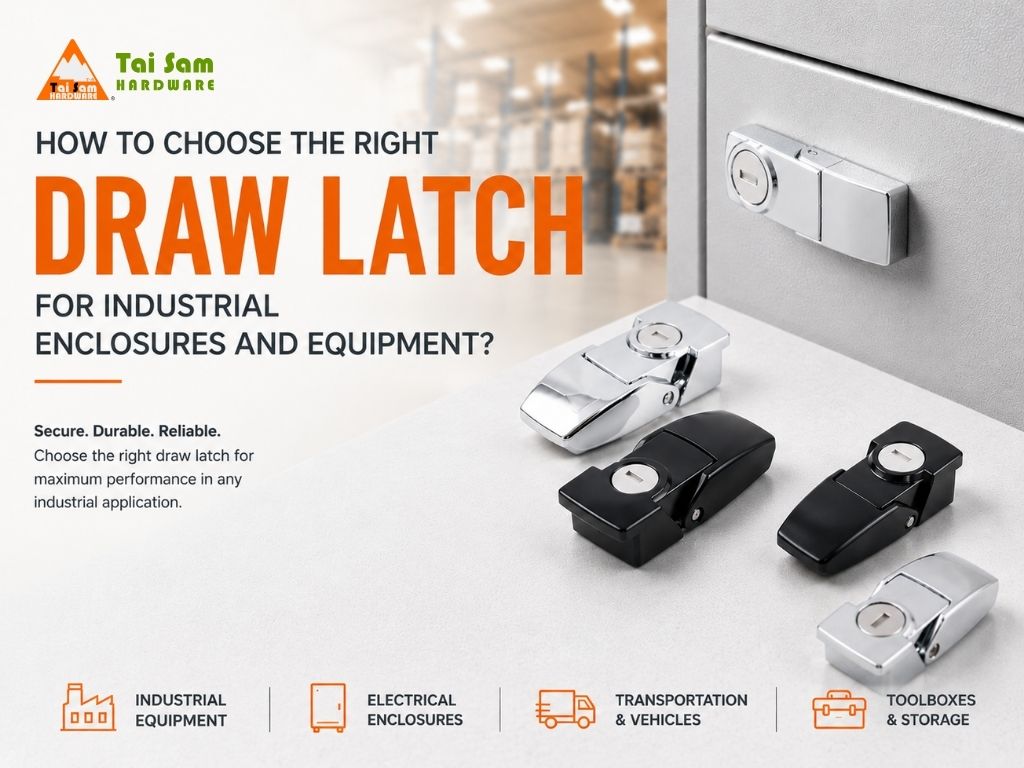
In industrial equipment and enclosure design, secure fastening systems are critical for both safety and operational reliability. Among the many fastening solutions available, the draw latch remains one of the most widely used components due to its simple structure, strong holding force, and quick locking operation.
From industrial enclosures and machine covers to transportation equipment and tool storage systems, draw latches help keep doors, lids, and panels securely closed even under vibration, movement, or repeated operation. However, selecting the wrong latch can result in poor sealing performance, structural loosening, excessive wear, or inconvenient operation.
At TAI SAM HARDWARE CO., LTD., we work with OEM manufacturers and industrial equipment designers across multiple industries. Based on our experience, this guide explains the key factors engineers and buyers should consider when selecting the right draw latch for industrial applications.
The first step when selecting a draw latch is determining how much holding force is required.
Important considerations include:
Weight of the panel or lid
Frequency of vibration or movement
Internal pressure or sealing force requirements
Safety requirements during transportation or operation
Heavy-duty industrial applications typically require stronger latch structures with reinforced hooks and thicker metal construction to prevent accidental opening.
For lightweight access panels, a compact draw latch may be sufficient and can improve usability and reduce installation space.
Environmental conditions directly affect latch durability and long-term reliability.
For indoor equipment with stable conditions, zinc-plated steel or zinc alloy draw latches often provide sufficient performance and cost efficiency.
For applications exposed to:
Humidity
Rain
Salt spray
Chemicals
Dust
stainless steel draw latches are highly recommended.
At TAI SAM HARDWARE, stainless steel latch options are available for applications requiring higher corrosion resistance and longer service life.
Industrial machinery, transportation equipment, generators, and mobile systems often operate under constant vibration.
In these conditions, the draw latch must provide:
Stable clamping force
Resistance to loosening
Consistent locking performance over repeated cycles
Adjustable draw latches are particularly useful because they allow engineers to fine-tune clamping pressure and compensate for wear over time.
This helps maintain structural stability and enclosure sealing performance.
Different applications require different latch structures.
Common draw latch styles include:
| Draw Latch Type | Characteristics |
|---|---|
| Standard Draw Latch | General-purpose fastening for industrial enclosures |
| Adjustable Draw Latch | Allows tension adjustment and stronger clamping control |
| Lockable Draw Latch | Includes padlock or key-lock capability for added security |
| Heavy-Duty Draw Latch | Designed for high-load and high-vibration environments |
| Stainless Steel Draw Latch | Enhanced corrosion resistance for outdoor or marine use |
Choosing the correct type ensures both functional performance and long-term durability.
Before selecting a draw latch, engineers should verify:
Available mounting space
Clearance during opening/closing
Hole spacing and installation dimensions
Panel alignment and tolerance
A latch that is too large may interfere with surrounding components, while an undersized latch may not provide sufficient clamping force.
Proper installation geometry also affects operational smoothness and service life.
In many industrial enclosures, the draw latch works together with a gasket or sealing strip.
Proper compression helps improve:
Dust protection
Water resistance
Noise reduction
Vibration isolation
Applications requiring higher IP protection levels often rely on adjustable draw latches to maintain consistent sealing pressure.
Besides functionality, appearance and surface protection are also important.
Common surface treatments include:
Zinc plating
Electropolishing
Black coating
Stainless steel brushed finish
The right finish improves both aesthetics and corrosion resistance while matching the overall equipment design.
Many OEM projects require customized latch solutions.
At TAI SAM HARDWARE CO., LTD., we support:
Custom dimensions
Adjustable holding force
Material customization
Surface treatment options
Locking mechanisms
OEM/ODM development support
This flexibility allows customers to integrate draw latches more effectively into their equipment designs.
A draw latch provides strong clamping force with quick and simple operation, making it ideal for industrial enclosures and equipment covers.
Stainless steel draw latches are recommended for outdoor, marine, high-humidity, or corrosive environments.
Adjustable draw latches allow users to modify clamping tension, which helps maintain sealing performance and compensate for wear.
Yes. When combined with proper gaskets, draw latches help maintain compression force and improve sealing effectiveness.
Yes, especially heavy-duty or adjustable draw latches designed for industrial and transportation applications.
Selecting the right draw latch requires more than choosing a basic fastening component. Engineers must evaluate:
Holding force
Environmental conditions
Vibration levels
Sealing requirements
Material durability
Installation geometry
By selecting the proper draw latch configuration, manufacturers can improve equipment safety, enclosure reliability, and long-term operational stability.
With extensive OEM experience and industrial hardware expertise, TAI SAM HARDWARE CO., LTD. provides reliable draw latch solutions for a wide range of industrial applications.
Whether you are designing industrial equipment, transportation systems, machine enclosures, or outdoor cabinets, choosing the right draw latch is essential for reliable performance.
Explore our industrial hardware solutions today and contact us for technical support, customization, or OEM development assistance.



This site uses cookies to improve your browsing experience. we’ll assume you’re OK to continue. If you want to read more about this, please click PRIVACY thank you.